People want things. There is not enough to satisfy everyone’s wants. People are capable of taking by force what they cannot have through agreement.
Everything we call politics follows from that. A political system is the machinery for deciding who gets what without the citizens killing each other over it. Constitutions, parliaments, courts, parties, unions, elections, bureaucracies are the scaffolding around this single function. A functioning political system is one that manages that coordination peacefully instead of violently.
We often describe political systems by their labels: democracy, autocracy, monarchy, theocracy. The labels tell us about the machinery and almost nothing about whether it works. Citizens ask a simple question “can I get more of what I want this year than last, and will my children get more than me?” A system that answers this with yes is legitimate almost regardless of its form. Political systems do not fail because they are the wrong type. They fail because they stop answering this question.
One question
Who gets what, and who decides becomes the fundamental arrangement in the system.
Notice that these are two disciplines compressed into one sentence. “Who gets what” is economics. “Who decides” is politics. They are conventionally taught as separate fields, which is a convenience but an analytical disaster, because no real society has ever encountered them separately. Distribution of wealth is what joins economics and politics. Economics asks how much there is. Politics asks who holds the authority to allocate it. Neither question can be answered without the other. A working political system is one that answers the question continuously and quietly, in a thousand small allocations, without anyone having to reach for a weapon. From the minimum wage to the capital gains tax, the zoning code to the monopoly laws, the university tuition to the landlord setting rent.
A failing political system is one where the answers to the question are not resolved peacefully.
Three conditions
A political system works and fulfills its function when three conditions hold. Take away the fancy political labels and every durable political system in history has had them.
Representation: Every constituency capable of disrupting the system has a channel into it. Note the phrasing — capable of disrupting, not morally deserving. This is a description of how systems survive, not of how they should be. A group with genuine grievances and no capacity to act on them can be ignored for centuries. A group with capacity and no channel will eventually use the capacity and challenge the system. Representation is the mechanism that converts potential disruption into political negotiation.
Common ground: Enough shared identity, values, or fate that constituencies can compromise at all. Compromise requires believing that the other side’s win is not your annihilation, and that belief requires believing you are in the same game. Where that belief exists, a conflict could be resolved through negotiation. Where it does not, the same conflict becomes existential, and there is nothing to negotiate.
Perceived justice: When conflicts arise, the process for settling them is accepted as legitimate by the losing side. Fairness is not a property of an arrangement. It is a belief about that arrangement, held by people who could otherwise cause disruption. A system can be substantively unfair but stable for a long time if the losers believe the process was fair. A system can be relatively fair but unstable if they do not. The gap between actual and perceived fairness is the territory where propaganda, scapegoating, and manufactured enemies operate. The reason those tools are always reached for is that they are far cheaper than closing the justice gap with substance.
When the system generates more wealth but some citizens do not see this reflected in their lives; then the system is perceived to have failed to distribute that wealth fairly. Losers stop perceiving the process as just — because a process that produces the same losers for decades does not look like a process, it looks like an arrangement, a caste system. Once justice is no longer perceived, people stop believing they are playing the same game as the winners. And once that belief goes, the common ground required to strike any compromise is gone with it. This is why systems in trouble appear paralyzed.
Four kinds of systems
How much of these conditions exist in a political system can give us a matrix to describe potential systems we can observe in reality.
We can look at the levels of representation and common ground to drive Perceived Justice. Representation answers a single question about voice: does everyone who could cause trouble have a way to be heard? Common ground governs something less obvious, muscle: when the state must impose a loss on its most powerful, will they accept it or resist? Common ground gives the state the muscle to distribute losses, and the perceived justice that follows replenishes the common ground that made it possible. Reverse it and the same loop runs the other way. Losses fall on the same people, justice drains, common ground goes with it, and with it the muscle to correct it. That is what makes decline self-reinforcing
For political systems to continue to work, they need to adapt by making adjustments to benefit the whole. Every real system adjustment — every land reform, every tax on capital, every breaking of a monopoly — takes something from people who currently have it and who would prefer to keep it. To understand this level of adaptability – which is the crucial part of understanding the survivability of a political system – we can create a four-quadrant matrix from Voice and Muscle to drive Perceived Justice.
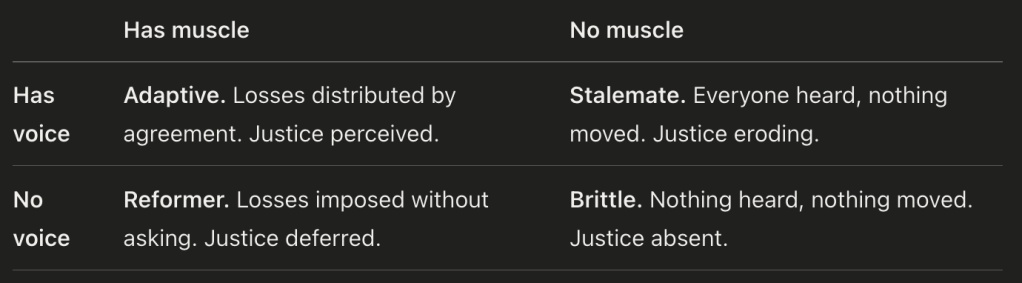
The adaptive quadrant is the postwar West for roughly a generation, and it is what most people now assume is simply what a wealthy democracy is. It is the hardest box to reach and the easiest to fall out of. Prosperity creates winners, and concentrated winners buy the rules that protect them. The system’s own achievements erode the conditions that produced them.
The reformer quadrant is where most rapid modernization has happened — Meiji Japan, Deng’s China, postwar Korea. What a state with muscle and no voice can do in five years will far exceed what a democracy can do in fifty. With every adjustment imposed rather than agreed, resentment accumulates, and the bill comes due. These systems adapt brilliantly until the day they need legitimacy, and then discover they never built any.
The brittle quadrant needs little explanation. It hears nothing and can do nothing, and it survives only until the first serious shock.
The stalemate quadrant is the most common destination for a successful democracy. A stalemate system is not broken in any visible way. Elections happen. Courts sit. Every constituency has representation, expert commissions produce sound recommendations, and the diagnosis of what is wrong is often widely shared across the political spectrum. However, the capacity to impose the cost of the fix on anyone able to fight back is lacking. So the fix is never applied, or it is applied to someone weaker, and the underlying problem compounds. It looks like a functioning system right up until it is asked to do something difficult.
The ticking clocks
Political Systems fail when the pressures that break them accumulate. There are internal pressures from within the system and there are also external pressures. Also, there is the factor of time which does not run in one clock.
There is a slow clock that runs on the physical substrate: climate, energy base, geography, and demography. It moves across generations and it is nearly invisible in daily life. The medium clock runs on accumulation: debt, wealth concentration, the migration of capital from production into finance and rent. It moves across decades. The fast clock runs on events: elections, crises, wars, leaders. This is where nearly all news commentary lives, and it is the least informative of the three.
The understanding of these clocks is what tells us which pressures are currently accumulating and therefore which adjustments are coming due. More critically, whether the adjustment the system is avoiding is one it can keep avoiding. Each clock carries its own pressures. On the slow clock, demography changes builds pressure overtime as in a youth bulge with no jobs to absorb it, or an aging society where those drawing on transfers outnumber those funding them. Also a shift in energy base can relocate rents from whoever held the old scarce resource to whoever holds the new one (coal → oil → minerals). On the medium clock, technology can re-prices whole categories of work, and winners compound in peacetime. Those holding assets earn returns, reinvest, buy influence over the rules governing returns, and compound again, with no single event anyone can point to. On the fast clock, wars and crises create claims that outlive them — promises made to soldiers, bondholders, and populations asked to sacrifice, coming due against an economy that has just destroyed part of itself.
Why too little is always done
With every adjustment a political system needs to make, the question does not become which fix and if it will work, but rather who pays for it. The political system will always select losers in order of their inability to resist.
The least to resist come first: future generations, who cannot vote, and diffused populations who are numerous but unorganized. Adjustments imposed on them barely register as decisions. They arrive as a shift in eligibility, a slow erosion of a service. The most to resist comes last: the organized and concentrated, who can fund opposition, capture regulators, and finance the veto.
The result is a system that responds to every crisis with the smallest available measure, applied to the least resistant group, which might relieve the symptom but leaves the cause. Do this for fifty years and you run out of people who won’t fight back, while the underlying imbalance is larger than when you started.
When the political system reaches the breaking point; two exits are possible. A shock breaks the veto of the current concentrated winners before their veto breaks the system — a depression, a defeat, something large enough that the winners’ ability to block is temporarily suspended. And a counter-elite is standing ready with a program, not just a grievance. Britain in 1832 and again in 1911. America between 1933 and 1945, when properties were taxed and regulated at levels unimaginable a decade earlier.
The second exit is a replacement. The adjustment happens anyway, through revolt, collapse, or war, and a new system is built from what remains. This is the modal case in the historical record — the great compressions of wealth across recorded history have arrived far more often through catastrophe than through legislation.
What the framework gives us is a set of questions to ask of any political system, in any era. Which constituencies have voice, and which have capacity but no channel. Whether enough common ground remains that the powerful will accept a loss. Which clock is running down, and what adjustment is being postponed. And whether, when the shock comes, anyone will be standing there with a program rather than a grievance.
Systems rarely die of their problems. They die of the arrangement that made the problems impossible to solve.
 AHMED BADRAN
Leave a comment